

A Midsummer Night’s Dream at The Young Vic Theatre
Directed by Joe Hill-Gibbins with design by Johannes Schütz
Main Cast: Michael Gould, Thesues/Oberon; Anastasia Hillie, Hipollyta/Titania; John Dagleish, Lysander; Jemima Rooper, Hermia; Oliver Alvin-Wilson, Demitrius; Anna Madely, Helena; The Mechanicals: Matthew Steer, Peter Quince; Leo Bill, Bottom; Sam Cox, Robin Starveling; Geoff Ayemer, Tom Snout. Lloyd Hutchinson; Egeus/Puck.
___
When we think of Shakespeare’s A Midsummer Night’s Dream, the sort of things that conventionally come to mind wouldn’t be out of place in one of those wonderful fairy-emporium shops – like those that Glastonbury is famous for. But this Dream, directed by Joe Hill-Gibbons, definitely stands outside of this. We’re in no a fantasy fairy wood – rather we are out in the field: literally and metaphorically. The characters stand on a semi-circular muddy stage, illuminated by harsh halogen bar lamps that run around the inner rim of its edge, and all backed by a mirror. Lovers will wrestle (both carnally and competitively) in this mud – as if it’s the last day at Glastonbury. This post-festival vibe seems a deliberate appeal to the idea that (as Emma Garland puts it in her piece for Noisey, ‘Having Sex at Festivals Isn’t Just Disgusting, It’s Shit.’) ‘summer music festivals are basically the closest thing humans have to mating season’[1]. For the mud covering the stage becomes a physical representation of love stripped bare – revealing it in all its messiness: un-idealised, raw, and at times grotesque. Yet we are also out of the fairy- wood in another sense. As we look at the stage we cannot avoid seeing ourselves – reflected in the mirror backing the stage. Indeed our faces might as well stand in for the trees of the wood where the Dream we are about to watch takes place.
At the same time, the mirror acts as a constant reminder that we are in fact an audience. It essentially removes the forth wall – like the signs held up by actors announcing the scene changes in Brecht’s theatre; an act that aimed to encourage the audience to recognise themselves as an audience, and therefore to be discouraged from over-identifying with the characters on stage, giving them space to adopt a more ‘socially critical’[2] attitude to the characters. But it’s not just the mirror that makes us feel disconcertingly alienated from the play’s main action. For whilst the characters all wear modern clothing (they could easily be any member of the audience), their movements stop us from becoming fully involved with them emotionally. Throughout the performance, none of them leave the stage (although sometimes they stand or sit in rows facing us along the shelf-like niches to the left and right of the mirror; they sip from bottles of water, almost as if we’re seeing the actors backstage). Instead they move around mechanically – like commuters-cum-cyborgs – creating different scene-zones on the bleak, and otherwise empty, stage. Sometimes they just stop, like puppets whose strings have been dropped, and face plant into the mud. They don’t seem quite human; or rather they seem to be humans controlled by some sort of impersonal force.
And, in many ways the characters in this play are. The plot is a tangled knot of love-ties made and un-made by magic, and often in response to social norms. At the play’s start we are met by Hermia, whose father (Egeus) is attempting to have her
‘consent to marry with Demetrius’,
instead of Lysander (the man with whom Hermia is in love). Lysander’s social standing is equivalent to that of Demetrius; Egeus is, on the face of it, more concerned by the fact that Hermia marrying Lysander would conflict with his having power over her according to the social norms of their society:
‘I beg the ancient privilege of Athens,
As she is mine, I may dispose of her:
Which shall be either to this gentleman
Or to her death, according to our law
Immediately provided in that case.’
He claims that Lysander has
‘With cunning […] filch’d my daughter’s heart,
Turn’d her obedience, which is due to me’.
It is to the Duke Theseus that Egeus ‘begs’. Theseus himself is soon to wed Hippolyta,  and
and
in this production an interesting parallel is drawn between Hermia (now lying face down in the mud, having heard Theseus support her father’s appeal: ‘to you your father should be as a god’) and Hippolyta. Before this scene we watched Hippolyta (dressed in a suffocatingly tight looking black suit) ritualistically put on high heels; she seems to struggle to put them on – and when she places her feet down the skinny-stilettos quickly sink and stick in the mud. Throughout the scene she appears to be almost limping. This ritualistic dressing in restrictive (and debilitating) clothing seems to reflect her restrained and almost fearful reaction to Theseus’ speaking of their soon to come wedding (and night):
‘O, methinks, how slow
This old moon wanes! she lingers my desires’.
Hippolyta looks on, rigid, going along with what is expected of her – she seems constrained by her situation, just like Hermia.
But unlike Hippolyta, Hermia decides to rebel – running away with Lysander into the woods. They are followed by Demetrius (who has been told of their eloping by Helena, who is in love with Demetrius and spurned by him). But the woods are inhabited by magical beings, and the lovers’ arguments disturb them. Puck (servant to Oberon the fairy-king) is sent by his master to quiet them down. He puts the juice of a plant that will make the recipient fall in love with whatever they see when they wake on Lysander’s eyelids – mistaking him for Demitrius (Oberon wanted Demitrius to fall for Helena). Lysander wakes to see Helena, and falls for her. In his interpretation of this element of the play, Hill-Gibbins seems to take some cues from Jan Kott’s (whose 1964 work Shakespeare Our Contemporary explored the direct connections he saw between Shakespeare and then-modern European drama, including Brecht and Beckett) feeling that ‘the reduction of characters to love partners seems to me the most peculiar characteristic of this cruel dream; and perhaps its most modern quality’[3]. Lysander and Demitrius wrestle in the mud, like male animals in mating season jacked-up on testosterone. They seem  completely out of control – or controlled by something beyond themselves. Of course the magic Puck has used on them is out of their control, but it is difficult not to read their animalistic behaviour as revealing our idea of human love (which we like to imagine exists on a level beyond the physical – we tend to idealise the notion of finding ‘the one’, or our ‘soulmate’) as, at base, an impersonal appetitive drive.
Even before Puck puts the juice of the plant on Lysander’s eyelids, we see this in action. As they lay down to sleep on the forest floor, Lysander tries to persuade Hermia to allow him to lie next to her:
‘One turf shall serve as pillow for us both;
One heart, one bed, two bosoms and one troth.’
She refuses him,
‘Nay, good Lysander […] lie further off’,
but he persists,
‘riddl[ing] very prettily’
(as Hermia puts it) to try and talk her into it. This is brief, and after her second rebuttal he seems to have learnt his lesson:
‘Amen, amen, to that fair prayer, say I;
And then end life when I end loyalty!
Here is my bed: sleep give thee all his rest!’
However, in this production we can’t be so sure. For as he ‘riddle[d]’ he was pulling Hermia into a close and distinctly sexual embrace: reaching under her skirt, and seeming not to hear her words as he started to lie her down. It is only with the help of her legs (kicking and pushing) that Hermia manages to force a response to her panicked
‘Lie further off’.
Even Lysander seems shocked at his behaviour – as if he doesn’t quite understand how he could have been so possessed.
Despite this, when Lysander turns in favour of Helena, the women behave just like the men – wrestling in the mud. They even throw handfuls of it at each other, along with verbal abuse (centring on physical attributes – Hermia’s being shorter than Helena):
‘Her height, forsooth, she hath prevail’d with him.
And are you grown so high in his esteem;
Because I am so dwarfish and so low?
How low am I, thou painted maypole? speak;
How low am I? I am not yet so low
But that my nails can reach unto thine eyes.’
It all sounds (excuse the anachronism) bizarrely Darwinian. If this is the state of young love, we are given an insight into more mature relationships in Theseus and Hippolyta, and Titania (the fairy-queen) and Oberon – who are both played by Michael Gould (Theseus/Oberon) and Anastasia Hillie (Hippolyta/Titania). These dual roles develop a parallel between the two pairs – although one between foils: Theseus’ sexual dominance, versus Oberon’s jealousy and feelings of sexual inadequacy; Hippolyta’s uptightness, versus Titania’s sexual yearning. We see Theseus at the play’s start looking in the mirror, flexing his muscles as he dons a black silk dressing gown – he looks like Hugh Hefner. Theseus’ dominating sexuality contrasts the sexual anxiety of Oberon. For he is angry that Titania refuses his request that she give up her page-boy to him. In retaliation he takes the same plant that he orders Puck to put on Lysander’s (and, later Demitrius’) eyes, and to use it on Titania – ensuring that when she wakes the first thing she sees is
‘some vile thing’.
This turns out to be Bottom – one of the Mechanicals (a small theatre band led by Peter Quint), who has been transfigured by Puck into a man with an ass’ head (making Oberon’s queen seem an ass for falling in love with an ass).
As Titania wakes from her fairy bower (in this production simply a patch of the mud covering the stage; in the foetal position she seems vulnerable) she sets eyes on Bottom – and falls in love. When she sees him Bottom (hilariously played by Leo Bill) is singing – but instead of the traditional song (which gives actors the opportunity to do their best impression of a donkey: ‘Whose note full many a man doth mark, / And dares not answer nay;-‘, hopefully rousing tumultuous giggles from the audience) he sings Aerosmith’s ‘I  Don’t Wanna Miss a Thing’. Whilst some might miss the traditional moment of comedy, Leo Bill’s increasingly whiney (and cringey) rendition of Aerosmith is truly hilarious – with each increase of volume drawing a peal of giggles, and eventually outright hard laughs. However the song choice also draws out the sexual politics between Titania and Oberon: ‘I could stay awake just to hear you breathing / Watch you smile while you are sleeping / While you’re far away and dreaming’, is both tender and not a little creepy – we could easily imagine the jealous Oberon singing it. But the song also fits in with this Bottom: he looks like a festival-going guy with his long hair, too-tight skinny jeans, wellies and aviator spectacles, exuding a sort of teenage sexual energy, which Titania seems to find exilherating – liberating, even. He seems to allow her to be more open with her sexuality. She takes great pleasure in caressing his ears – which are actually a pair of stuffed nude tights (reminiscent of Tracey Emin’s ‘My Bed’; he wears another pair on his arms, and he also wears another pair around his waist – except that this is stuffed with an empty Evian bottle, and is unmistakably phallic). Bottom taps into a deep vein of Titania’s sexuality: raw, inelegant, and dirty. We see this in particular when Titania calls upon three of her ‘fairies’ to serve Bottom:
‘Peaseblossom! Cobweb! Moth! and Mustardseed!’
No fairies come. Instead Titania takes on their roles – in a sort of erotic role play. Even Bottom seems sexed-out by her; in response to her role-playing there comes only an abashed ‘sorry’. Perhaps this is why she refuses to hand over her page-boy to Oberon – the latter cannot give her what she needs.
It seems that Oberon has underestimated the power of Titania’s sexual appetites. Later, when Hillie (Titania) is again Hippolyta, Bottom’s (now in the role of Pyramus as part of the play the Mechanicals put on for Theseus and Hippolyta’s wedding) speech in anguish believing his lover, Thisbe, to have been killed by a lion, Hippolyta is moved –
‘Beshrew my heart, but I pity the man.’
It’s as if a switch has clicked in her head; for from here on out she seems more Titania than Hippolyta. Bottom too seems to recognise her, and he addresses his speeches (as Pyrimus) to her – stressing, in particular, their carnal imagery –
‘Come, come to me,
With hands as pale as milk;
Lay them in gore…’
– as they grow closer and closer, eventually entwining themselves, as they sink onto the muddy ground. Again lovers are ‘reduc[ed…] to love partners’ only – something that is emphasised by the farcical performance of the Mechanicals (acting as if acting badly is  notoriously difficult, but these Mechanicals do it well – Sam Cox’s teenagerly-defiant ‘Moon’ and Aaron Heffernan’s childishly-fastidious Thisbe are particularly good). They perform the Tragedy of Pyramus and Thisbe – before Pyramus believes his lover, Thisbe, to have been killed by a lion, they whispered their love to one another through a wall (a physical symbol of their families’ denial of their wanting to be together). But when he believes his lover to have been killed he rashly throws himself on his sword – and, when Thisbe returns, seeing her love dead, kills herself too.
We hold this narrative as an idealised view of true love: it is, in essence, that of Romeo and Juliet (the plot of which Shakespeare’s 16th to early-17t century audience would have been familiar with, just as we are today). But it is undeniable that there is a degree of comedy in the extremity of the lovers’ impulsive actions – even something of the grotesque. The Mechanicals’ performance is meant to be amateurish, but the degree to which their performance hangs together as something that we can still term a ‘performance’ is a matter of direction. Hill-Gibbins chooses to allow it to totally dissolve (with Bottom’s becoming descending into the mud with Hippolyta/Titania in a quasi-carnal embrace) – drawing out the grotesque element in the Mechanical’s show. For example the Lion wears only his underwear, and one of the stuffed pairs of tights that were Bottom’s ears; when he roars he does so flailing his arms about madly. This makes the formal (almost courtly) commentary of the characters watching the play (Theseus, Hippolyta, Lysander, Hermia,  Helena, and Demitrius) seem completely disjointed – perhaps suggesting that the notions of love that we sustain in society (e.g. idealising ‘the one’ – as Romeo and Juliet do to one another, so much so that they choose to die as opposed to living without their respective ‘one’) fail to marry up with love in reality. The broken figures of Hermia – face in the mud at the feet of Lysander – Demetrius and Helena, on either side of the Mechanical’s ‘stage’ epitomise this: the mud they are caked in seems a sort of metaphor for the emotional damage love has done to them.
We might say that ‘love’ has caused them this pain, but it was Puck who took Lysander for  Demitrius (Oberon sent him to use magic on Demitrius to make him fall for Helena), and thereby set the lovers sparring in the mud. It seems that Kott’s influence is also strongly seen in this Puck. Kott’s Puck is not ‘just a playful dwarf from a German fairy tale, or even a poetic gremlin in the fashion of a romantic féerie’[4], and nor is Hill-Gibbins’. This Puck is an ageing punk, irritable, and bitter – he wears a scraggy red and back wig. His mistaking Lysander for Demitrius is not a ‘playful’ gaffe, but rather an act of deliberate negligence: he simply doesn’t care. In this regard it seems Kott’s influence can be seen in a far more fundamental sense, for it is Puck who ‘pulls all the characters on strings’[5], ‘put[ting] the mechanism of this world in motion’[6] (manipulating relationships of love; he might even be seen as the mechanism of love in physical form) – and in this production, as he does so, he literally ‘puts it in motion and mocks it at the same time’[7]. When Oberon demonstrates (with many elaborate gestures) how the juice of the plant is to be used, as he
‘streak[s Titania’s] eyes’
with it, Puck imitates him self-mockingly – and when it comes to his actually using the plant he goes further. Instead of miming the delicate placement of the plant’s juice onto Lysander’s eyes (as Oberon showed him) he takes one of the bottles of water (sat on the shelf-like part of the back wall) and drips it onto Lysander’s head; he looks up at the audience grinning – waiting for a response. We laugh; he opens the bottle again and proceeds to empty its contents onto Lysander’s head. We laugh again, more loudly this time – his seemingly excessive cruelty is oddly funny; he begins to beat Lysander with the empty bottle.
Therefore, if we do understand this Puck as in some sense to represent the mechanism of love (‘the mechanism of this world’; it is worth adding that he occasionally acts like a stage director – albeit one who is apathetic to the health of his actors – he violently throws Demitrius and Lysander from the shelf-like niches along the back wall onto the stage), we simultaneously find ourselves regarding him as personifying cruelty, and indifference. The last of these are reflected in other moments. For example when Bottom (now returned to his fully human form) tediously runs in circles around the stage – until he is tripped up by Puck, when he continues his laps, but now on all fours like an ape or a baby. This is funny – but in the absurd sense. For it seems that, like the character’s in the Absurdist plays of Beckett (that are often read as presenting worlds that are apparently indifferent to humanity, and where human life has no inherent value or meaning), Bottom is going nowhere (even regressing – devolving into an apish/baby-like crawl) – and is not helped by the apparently arbitrary action of ‘the mechanism of this world’ (Puck). As the play draws to a close the cast, led by Titania (who holds Bottom’s hand), all join hands in a long  line; she runs – pulling everyone along with her – running them in circles, and what seems like impossible knots. However, the chain remains single-file: everyone is left chasing – never catching, never making a meaningful connection.
Still in single-file, they press themselves against the mirror (which has been mostly painted over; now it is simply a black wall – with the exception of a small section at the top in which we can see only ourselves), with their backs to the audience. This effectively isolates us, the audience, from the characters – who jump as if trying to reach the reflected faces (our faces) in the small strip of mirror left unpainted. Hermia draws giggles from us as she jumps more aggressively than the rest to make up for her being (in her own words) ‘so dwarfish’. Is it cruel for us to laugh? Or do we laugh to distract ourselves from the disconcerting sense that these characters have suggested (and are suggesting) to us that love is not what we think it to be? For in the world they present us, love is not an idealised vision of finding ‘the one’ or our ‘soulmate’, rather it is a a case of impersonal forces drive people together (just as they may drive us apart – consider the case of Lysander and Hermia). Further, as they stand reaching up to our reflections in the mirror, they seem to question the the very notion of being ‘together’ – challenging the idea that we really can form meaningful human connections at all.
Some have said of that this production of Dream ‘dispenses with all of the magic and much of the comedy’[8]. They aren’t wrong. The laughs evoked by this comedy are not jovial – they aren’t full of the warmth of a midsummers’ night. Rather they are laughs spurred by disorientation and discomfort when two contrary ideas collide (challenging a conventionally held conceptions). They are the laughs the idea of a ‘British summer’ can bring, or the seemingly crazy and carnal acts attending music festivals (like Glastonbury) can unleash. And whilst its arguable that the striking staging might detract from the poetry of Shakespeare’s words (as might the focus on physical theatre – for example Bottom’s running around the stage), it might equally be said that it draws out challenging themes that our conventional fairytale-like conception of Dream shies away from. Puck ( delivers the last words of Dream:
‘If we shadows have offended,
Think but this, and all is mended,
That you have but slumber’d here
While these visions did appear.
And this weak and idle theme,
No more yielding but a dream,
Gentles, do not reprehend:
if you pardon, we will mend:
And, as I am an honest Puck,
If we have unearned luck
Now to ‘scape the serpent’s tongue,
We will make amends ere long;
Else the Puck a liar call;
So, good night unto you all.
Give me your hands, if we be friends,
And Robin shall restore amends.’
This production asks us to take a position: to stay in a dream of love as we imagine it (an idealised quest where finding ‘the one’, or our ‘soulmate’ is possible: ‘think but this, and all is mended’), or to wake up to its realities (as this production presents them – perhaps epitomised in the arbitrary, indifferent, and sometimes cruel Puck: ‘the mechanism of this world’). Do we ‘the Puck a liar call’? That’s up to you.
___
More information about the production can be found at: http://www.youngvic.org/whats-on/a-midsummer-nights-dream
___
by Emily Swettenham
7th March 2017.
___
References:
[1] Garland, E. 2014. ‘Having Sex at Festivals Isn’t Just Disgusting, It’s Shit’. Noisey. [online]. Available at: https://noisey.vice.com/en_uk/article/having-sex-at-festivals-isnt-just-disgusting-its-shit [Accessed: 7th March 2016].
[2] Brecht, B. Collated by Bloomsbury Methuen Drama. Translated by Davis, J., Fursland, R., Giles, S., Hill, V., Imbrigotta, K., Silberman, M. and Willett, J. Edited by Silberman, M., Giles, S. and Kuhn, T. 2015. Brecht on Theatre. Third Edition. Bloomsbury Publishing Plc.: London. p.g.187.
[3] Kott, J. Translated by Taborski, B. 1964. ‘Titania and the Ass’s Head’. Shakespeare Our Contemporary. Methuen & Co. Ltd.: London. p.g.176.
[4] Ibid. p.g.172.
[5] Ibid. p.g.174.
[6] Ibid.
[7] Ibid.
[8] Hemmings, S. 2017. ‘A midsummer night’s misogyny at the Young Vic’. The Financial Times. [online]. Available at: https://www.ft.com/content/1a715050-fa91-11e6-9516-2d969e0d3b65 [Accessed: 7th March 2016].

 collaboration with tech-giant Intel (in association with Imaginarium Studios), and employs some of the most advanced technology ever seen in theatre. This is perhaps appropriate for a play that was written in the early Jacobean period, when the theatrical vogue was the masque; elaborate and often extravagant performances that incorporated music and dance alongside drama delivered by masked actors[2]. Indeed, The Tempest itself contains a masque (the ‘vanity of mine art’ that Prospero conjures to celebrate the nuptials of his daughter, Miranda, and Alonso, the King of Milan’s son, Ferdinand) and seems to have been written with some intent to exploit the technical innovations that the masque form brought with it. Not least because originally it was to be performed at the Blackfriars (a small, intimate and enclosed theatre, unlike the open-air Globe – better equipped to support the mechanical requirements of masques). But more importantly the centrality of magic to the plot, (for example in the tempest Prospero generates that opens the play, bringing the play its cast of castaways, which makes all of the goings-on that follow possible) would have given more opportunities to employ the theatrical machinery of masques in new, and more serious ways.
 inexorably pulled down by his back, drowning, towards the stage floor. Prospero looks on. Although we will later discover that no one really drowned, it is this frightening image that introduces us to the magnitude of Prospero’s ‘art’: beautiful, astonishing, but simultaneously terrible – all of which he recognises and understands.
 and proceeds to
 an exercise in rhetoric – justifying his unsound claim to Ariel’s loyalty (is Prospero’s taking him into his ‘service’ in some sense equivalent to Sycorax’s ‘imprison[ing]’ a ‘spirit’ like Ariel into a ‘cloven pine’?). Doran employs special effects to explore this – hinting at the latter. For as Prospero delivers this speech, the spiral of fabric (that the figure of the man ‘drowned’ down) descends around Ariel – encircling him like the trunk of the ‘cloven pine’. And with each bitterly delivered descriptor Prospero gives of Ariel’s imprisonment, a new projection is cast across the stage, transfiguring it into a net of roots, and directly onto Ariel, appearing to transform him into wood. The effect is truly astonishing – and totally absorbing, especially with the accompanying audio of wood creaking (seeming to echo Ariel’s physically appearing to break under the force of Prospero’s magic) that sounds like bones cracking – or whips. Instead of undermining the power of the characters’ words, the special effects draw out their moral complexities and ambiguities – bringing them into sharper relief.
 dresses organic looking fabric and tudor silhouettes. Further the setting for the masque is totally immersive; indeed the feathers of the peacocks that
 ‘this man and maid,
 pted by that which he has caused in her. Just as he clearly cares about her emotional state, he also appears to value her perspective (although he may not actually act on her advice, he respects her point of view – he is not simply dismissive of it) – and enjoys her inquisitiveness, despite the fact that her questions interrupt him. But perhaps most importantly he seems to need Miranda to sustain him emotionally. As he tells her of his mental anguish when adrift at sea, he kneels to her, clasping her hands, gazing up into her face – suppliant-like – and tells her, with deep tenderness
 For Beale’s Prospero is vulnerable; less of a self-convinced patriarch, he seems self-conscious and self-doubting. This is reflected in his simple clothing: he wears loose-fitting cheesecloth top and trousers – no grand magician, despite the huge power we know he wields. His gait is nervous: he rarely stays still, and agitatedly grinds his hands into his pockets. Several possible explanations for his being in such a state are suggested to us. But first and foremost are his feelings towards his past: for he cannot seem to be able to understand where the aggressive ambition of his brother came from (he thought he knew his brother well) and further how he could act upon this ambition as he did – attempting not only to unseat his Prospero, but to kill him and his daughter. This is made clear when Prospero is telling Miranda ‘how thou camest here’. Beale delivers a sharp mix of confused rage, hurt, and worry as he tries to verbally reconcile how, in his brother
 Moreover this drift-wood staff also associates Prospero’s ‘art’ with the shell of the wrecked ship that encloses the stage (and all of his conjurings) – and thereby the mental tempest caused by his and Miranda’s shipwrecking. The ship’s ribs seem reminiscent of a whale’s (indeed the production’s use of special effects was greatly ‘inspired’[4] by Intel’s Leviathan[5], a CGI whale projected onto a screen that then literally swims out of it) calling to mind the many ‘monster[s] of the deep’[6] that feature in the Bible – particularly at times of human suffering, for example in Job. In his misery (a diligently pious man, Job’s faith is tested by God who gives Satan ‘power’[7] over ‘all that he hath’[8] – ‘only upon himself put not forth thine hand’[9]), having lost his family, home, wealth, and suffering numerous other hardships besides, Job protests, asking ‘Am I a sea, or a whale, that thou settest a watch over me?’[10], drawing on the image of the universe as chaotic waters (as in Genesis 1: ‘darkness was upon the face of the deep. And the Spirit of God moved upon the face of the waters.’[11]) that God imposes order upon. In Job, it might be argued that his grief, his utter misery and despair at the apparent futility of life (‘my soul chooseth strangling, and death rather than my life’[12]), is of a degree that is as desperately chaotic as ‘a sea, or a whale’, or ‘the deep’ God must restrain to keep order in the universe: Beale’s Prospero channels something of this energy, in his anxiety, self-doubt – but most importantly, in his sudden rages, that seem borne of a chaotic, tempestuous mind, that has suffered and needs to right his feelings of being wronged. Like Job finds himself incapable of ‘refrain[ing his] mouth’[13] from ‘speak[ing] in the anguish of [his] spirit’[14], this Prospero in some sense must attempt to orchestrate his own poetic justice – to reinstate order in a world that he may find, ultimately, to be fathomless.
 he addressed Miranda he referred to her as a ‘goddess’). Whilst Miranda is set on marrying Ferdinand, the possibility that he may not live up to her expectations seems to bother Prospero (the masque itself seems to be a sort of utopian vision of the world he wishes he could give to her) – but not enough to change his plans. Maybe he thinks that, in time, he will be able to correct Ferdinand? His teacherly manner towards him – setting the lovers-test of piling up a ‘some thousand’ logs (which this Ferdinand does with much comic huffing and puffing – and help from Miranda, who is much more able than he) – might suggest as much. However, whether we think Prospero will manage this, or that his judgement is in any way sound is very much open to question.
 band of spirits in the form of dogs to hunt them. Rendered with the special effects, the result is truly terrifying. The faces of three dogs (like Cerberus, the three-headed dog of the underworld owned by Hades), glowing a shockingly bright red (that is so bright it almost makes our eyes burn – as if Prospero is somehow indirectly, even inadvertently, punishing us), growling and barking through gaping jaws, are projected onto the back of the stage – whilst, in the foreground, spirits (clad in white morphsuits) holding white discs onto which more dog faces are projected. They chase the ‘confederates’ about the stage – who shriek and scream as Prospero condones their (and ours, as we blink at the red light and wince at the harsh too-loud sounds of the dogs) suffering:
 – informing them that they are to be punished for the wrong they did to Prospero and then setting three anonymous spirit-swordsmen to fight with Alonso, Sebastian, and Antonio (whom Sebastian tried to tempt into killing Alonso). This is all to teach them a lesson – to achieve his poetic justice. He sets the scene for this – placing himself in the centre of the circle of fire (rendered via projection) that he draws on the ground with his staff, as he simultaneously draws the enchanted Alonso, Sebastian, and Antonio (whose clothes are tattered and bloodied) about its circumference; Gonzalo, who is still neatly dressed, is also drawn in. Prospero’s
  moment has come. Before he breaks the spell he goes up to each and professes to forgive them; he then costumes himself in a military jacket (like those worn by the King and the rest of his party) and breaks the spell. He stands, awaiting their reactions, happily holding his arms out – as if to say ‘Tah-Dah!’ Standing as he is in the middle of the circle he seems hunted – even a little foolish. No one reacts – and then, when they do, it’s not to tell Prospero that they repent. It seems that Prospero has grossly misjudged his audience. Even Gonzalo, whom Prospero thought so ‘noble’ and ‘charitable’ receives him with a guarded look: brilliantly delivered by Joseph Mydell – who balances a veneer of benignity with hawkish self-interest. Stephano barely speaks; he barely moves – remaining icily still as his brother embraces him. The only one of these men who truly appears to believe Prospero’s claims is Alonso, who is himself on the brink of madness because of what he has suffered at the hands of Prospero (Alonso also believes his son to be dead). As Alonso embraces Prospero it seems that the latter might be just as mad as the former.

 where we are situated – looking onto the ice-sheet stretching out from the shore). From time to time, a train moves jerkily along a track running through the trees. It looks simultaneously real and toylike – expressive of vast distance yet clearly unreal: like something from an Aardman-made stop-motion animation film. As the audience took their seats before the play even began, this mini fishing hut glowed with a light from within – presumably left on by its (assumed) occupant, the tiny puppet fisherman standing outside. As the auditorium’s lights dim, a voice tells us (from nowhere):
 hat!’
hat!’ continuing to create an image of himself as a saint in a sort of mystical state, but one whose rapture is
 ‘Seven Ages of Man’, ‘all the world’s a stage…’ with an edge that hints at this being a little tired – but nonetheless true),
 ‘the phone might ring you from anywhere; the car, the bathroom, out of your coat pocket in a silent darkened theatre…’
 e absence, the loss of any such clear and well-defined systems of beliefs or values […] suddenly Man sees himself faced with a universe that is both frightening and illogical – in a word, absurd.’[6] In the universe of Nice Fish some logic remains, and in this sense it is substantial – not just a whimsical take on the Absurdist mode. Just before the closing scene, they remove their cold weather gear to initially reveal the conventional uniform of office workers. Hands reach up through the holes in the ice, holding cards that Ron reads:
 substance in life, even if (paradoxically) what we are laughing at is the apparent absurdity or meaninglessness of existence. In this sense Nice Fish suggests that it is perhaps worth making the most of the minutia of experience (despite the fact
 the air acquires a sort of musky allure. Vital to this extraordinary mood is the personal contact Bianco’s performers are afforded with their audience; for the tent has neither a ring, nor a ringmaster. Instead the audience stands, whilst the performers weave through them – doing their own thing. Although there is no central ring at this circus, there is (initially) a scaffolding that encloses the central area of the tent. It is wrapped in a gauzy fabric that the performers peel up as they casually clamber into (or up onto – dangling carelessly over or heads) this central space. They come together loosely, informally, and almost instinctively – chatting and swaggering about (casting huge shadows), loudly enjoying the inside jokes they have amongst themselves; calling to one another in a pan-cultural patois (including Italian, Spanish and French amongst others), in the same breath as they chat animatedly to (or just stare at) members of the audience – both inside and outside of the gauze. They are simultaneously friendly and intimidating, enticing and frightening, relatable and superhuman; moving between these expressions of character as quickly as the audience is (literally) moved around the performances.
 his safety wire; but we laugh both at the intended hilarity of the moment and at our feeling slightly trepidatious. And that helps us to let go – to let our guard down. So too does being a part of a constantly moving audience. Gradually the fear that you might tread on someone’s feet, or commit some other faux pas, dissolves the more we are moved around together – although this comes with a caveat, if you’re five-foot-one, like me. Others have reported seeing ‘a six-foot man bend down to check that the woman who is barely brushing five feet can see’[2]: I wish that had been me.
 However, visibility issues aside, immersion in Bianco’s world is immensely liberating; for the logic of its universe is one where contradictions can coexist. Or, as the show’s director Firenza Guidi puts it, one where ‘there is only passion, the messiness and infectiousness of life’[3]. But don’t assume that this is code for complete confusion: although we are presented with no consistent narrative, strong themes emerge. These range from something as light as the childlike pleasure in achievement (as in Francois Bouvier’s tightrope, where he completes a backflip, punches the air and joyfully points to himself), to something as heavy as the boulder the gods of Greek mythology force Sisyphus to repeatedly push up a hill, only to watch it roll back down and hit him. Camus regarded Sisyphus as ‘the absurd hero’[4], (whose ‘whole being is exerted toward accomplishing nothing’[5], and is trapped by his fate; yet is paradoxically fulfilled by his choice to embrace his fate) a
 nd there is something of the absurd in some of Bianco’s acts. For example the aerial silk performance of Danilo de Campos Pachecos: as he repeatedly climbs up his silks, with huge energy (muscles, that clearly indicate his skill and the effort he has put into this performance, visibly working) he suddenly falls, and hangs completely prone – like a puppet. Other images of human attempts at self-assertion, juxtaposed with entrapment are scattered throughout Bianco: from the aerial door-way shaped boxes a performer climbs through to open the show, to Delia Ceruti’s aerial rope performance, where she
  literally ties herself in knots.
 re the audience’s freedom to move comes into its own; because the angle from which you view each act affects how you interpret it – and each person has the opportunity to find their own viewing sweet spot. As I watched her wrap the rope around her waist, and pull it up in front of her so that she could ‘walk’ along it at the same time (see the image to the right), my vantage point emphasised the restrictiveness of what she was doing to herself; for the rope constricted her waist, like a corset, and the rope-path she walked along (the rope she held in front of herself) seemed all too much like a self-inflicted tightrope – implying a fear of falling.
 he air (only just stopping himself from hitting the ground) from the peak of the tent’s top. As snowflakes begin to fall (inside the tent) he flies in circles – soaring, held up only by his own physical strength conducted through the thin straps supporting him. He is perfectly elegant – he clips his toe (not a usual occurrence as far as this reviewer could judge) on the scaffold that has been constructed and re-constructed around us throughout the show; but he ignores it. He pushes on. He starts to create his own his own weather, his own tornado in the snow swirling about him as he turns within it. He lands, then the audience is invited to the centre of the tent to enjoy the snow too. We can’t fly through it as he did, but the collective euphoria makes us feel, for a moment as if we could.
 Lazarus starts with an old face: Thomas Jerome Newton. He is still stranded on earth (after his first attempt at building a rocket – seen in Roeg’s film) and we find him in his beige apartment, furnished sparsely: a fridge and record player against the righthand wall, and a bed on the opposite. As we quickly discover, Mary Lou (Newton’s lover in Roeg’s film) is no longer around. Nor is the dream that somehow he might return to his family on his home planet:
 are emerging from the screen itself – as if it’s a sort of physical metaphor for Newton’s mind. This is firstly implied by the images of Mary Lou that dance across it, and because the strange celestial Girl (who claims she is there to ‘help’ Newton) – dismissed as
 Romanticism) that once belonged to Mary Lou. She then returns to the figures on the screen and violently circles her hand around the couple – leaving a scribbly red line as if circling something she desperately wants in a catalogue. This is all indicative of the fact that the line between Newton’s mental world and reality is blurred – and increasingly so. Later she will dye her hair blue and continue to transform herself into the image of Mary Lou that intermittently dances on the screen; making it difficult to tell if it’s she who is imposing herself upon the extraordinary Newton to escape her un-extraordinary life, or whether he is imposing the image of Mary Lou onto her.
 Mary Lou, sits in front of the screen (with a picture of Mary Lou on it, dancing behind a crouching Newton) facing the Girl, who is herself dressed as Mary Lou as she attempts to put on a ‘play’ to help Newton
 across the apartment’s large plain glass windows, that don’t look out onto the New York skyline but rather onto what seems to be a recording studio (where the live musicians really perform) – a starkly naturalistic contrast to the hallucinatory atmosphere of the front of stage (Newton’s flat). The screen stands between these windows (like the brain sits behind and between the eyes) suggesting that the dream world of Newton’s flat is a sort of inner reality; perhaps even an entirely mental one. This is apparently reinforced by the fact that often the characters who interact in the dream world of Newton’s flat press themselves up against these windows – as if trying to get out or to impress their feeling onto the musicians in the recording studio: as if to achieve escape through musical expression in the ‘real’ world. If we were to read Lazarus biographically, we might relate
  this to Bowie’s creative process.
 and rocket fuel, but rather from tape that the Girl uses to draw the rocket’s shape on the stage. Whilst this new ‘rocket’ looks disconcertingly like a coffin, (and Michael C. Hall all too much like Bowie as he lies in it, his face projected large on the screen) Newton’s final flight doesn’t appear like Bowie’s; rather it seems more of a universal metaphor implying a search for the freedom to be ourselves in a world that often fails to meet our expectations: as the Girl says
 by Mary Lou:
 death – caught between two worlds like Newton. Then she asks Newton to
 both because of and despite the fact that they are
 Pill’s reference to Bernard Shaw’s Major Barbera is no coincidence. iHo’s title is actually a reference to Shaw’s 1928 work The Intelligent Woman’s Guide to Socialism and Capitalism (a ‘blend’[3] of Marxism’s ‘soaring idealism and no-nonsense realism’[4], expressing ‘belief in the parliamentary route to socialism, [with] no illusions about the unsatisfactory deficits in democracy’[5]) and in this vein Major Barbara’s subtitle could easily describe Kushner’s play: ‘A Discussion, in Three Acts’. For iHo examines the alienation of our progressively technologically mediated lives in a market-orientated neoliberal society; where the social fabric is being gradually unravelled to reveal a generation of individuals drifting in a globalising world. In iHo, Kushner brings the ideas of Marx to bear on our experience of this: suggesting that ‘in some way Marx saw this coming [… consider the] principle of the increasing abstraction of value equalling the the increasing abstraction of human life – well, the digital age is the most shocking realisation of that’[6].
 he is also called Vin, Vic, Vinnie and – most often – V. They also live lives of insecurity, disloyalty and deceit. Vito probably has the most stable life; but that’s not saying much.
 Lawyer and aided Gus on campaigns when she was little) and, to a certain extent, is accepting of Gus’ attempts at suicide – sitting with him and the widow of a fellow ILWU member, as the latter explains how she aided her husband in his suicide, listening for instruction on how to help her father do the same. She does this because she sees Gus as heroic –
 Clothier – explains in great detail to Eli, as he straddles him on his bed) posits that work, when we are in control of both the means and the ends of production, is what makes us human: it is our ‘species-being’. In Marx’s conception this is why Revolution is needed: to restore the means and ends of production to the workers (who have had these taken from them by the capitalist) and in so doing, restore to them their ‘species-being’ – their fullness of life. But in Pill’s mind, this idea becomes sensual – as he sees what he does with Eli as expressive of ‘species-being’ in a sexual sense; for Eli controls and receives both the means and the ends of what he is producing (the sex act). Yet Eli has a more capitalistic conception of what he is doing – eroticising the notion of his being a commodity; something that someone desires so much that they are willing to pay for him.
 predominating political theories of the past, in light of the present. In fact, in their relationships, many of the arguments against Marx can be read. In Pill and Eli’s case, as well as Empty’s, this is seen in the interrelationship between the theoretical and the emotional: as Eli says
 come back to this later), and even exasperatedly claims himself as a
 main characters are on stage each talking over one another, spread out and many in motion, a lack of understanding on the part of the audience seems intentional. We live in an increasingly complex world where the internet has made multiple forms of information and perspectives readily accessible – so much so, that, in the wake of Brexit and the rise of Trump, many (such as Katherine Viner) are now arguing that that the status of the idea of plain fact or truth is ‘diminishing’[12]. Like Gus we are in the midst of a crisis of belief – where our faith in old conceptions of ‘how the world works’ are being challenged by new and weird concepts, like the notion of our living in a ‘post-truth’ (the OED’s 2016 International Word of the Year, ‘an adjective relating to circumstances in which objective facts are less influential in shaping public opinion than emotional appeals’[13]) age, particularly in terms of politics[14]. To me this play, and all its sprawling complexity, asks us to address this.
 stream media, and charities (such as Cancer Research UK, ‘so many lives lost […] but we fought on’ [3]), to raise funds; giving a rise to a sort of mythic narrative that can act as a ‘barrier to normalising cancer’ [4], isolating both society and the individuals dealing with a diagnosis. Kimmings show sets cancer not on a battlefield but in what seems an average room in any old NHS hospital. Each of the grey, ceiling-tiled walls that enclose the stage has a double door (the kind that makes it easy for gurneys push open), and basic slatted blinds conceal the musicians. Initially the cast are dressed like anyone you might meet on the street, and in a highly choreographed manner they mime walking (as if) in streets – singing about knowing that cancer could happen to any of them, but that
 being in a hospital environment amongst people whose interactions and behaviours are somewhat dictated by sickness:
 f anger and fear’ [11] upon finding out you have cancer, ‘all of which must be buried under a cosmetic layer of cheer’[12]. This attitude is echoed by Gia, who looks up from one of the iPads and talks about the articles on Buzzfeed she has been reading, all of which present the ‘positive stories’ of ‘positive cancer patients’ – working herself into a fury, and eventually
 characters around. Bizarre as they are, these characters embody the jangling tones of this show. They represent the strange and frightening world of cancer as they follow those in the ‘Kingdom of the Sick’ but one of them also puts cancer in its simplest and least frightening terms. Jovially she sings, to a nursery-rhyme like tune,
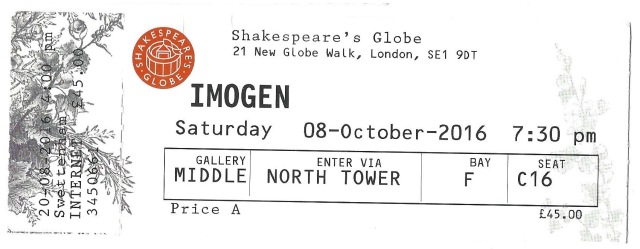 Imogen or Shakespeare’s Cymbeline at The Globe Theatre
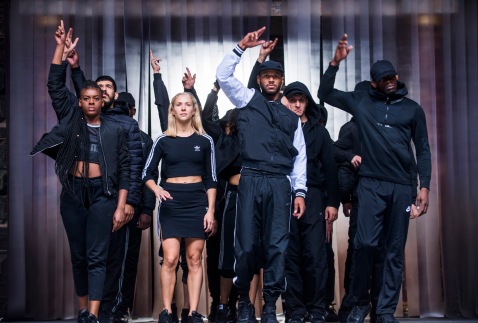 Keeping beat with the music they simulate drug preparation – choreographically cutting and scraping this ‘substance’ into jiffy bags. With this, we are immediately submerged in a tough world of gang-warfare on the streets of 2016 London; an interesting modernisation of Shakespeare’s original setting of Cymbeline – another harsh world although of ancient, Celtic Britain, ruled by King Cymbeline and occupied by the Romans. Dunster translates Shakespeare’s presentation of Ancient Britons who are rebelling against Julius Caesar’s imposition into a battle between rival drug-gangs – Cymbeline’s London gang (who wear black) versus the Italian ‘Romans’, headed by ‘Caesar’ (who wear white). It is in this mess that Imogen finds herself trapped.
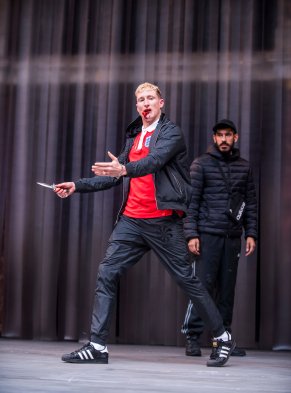 play. Most particularly when Cloten attempts to court Imogen by waiting outside of her bedchamber to wake her with music. Playing the music (loud, electronic) and snorting coke off of his hand he struts around outside her room and says (accompanied with gross, lewd gestures),
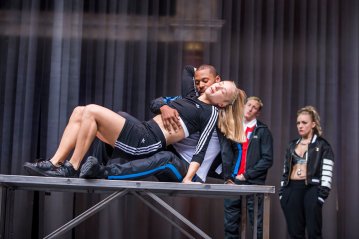 to prove that he has slept with her (a lie) more believable – if Posthumous and Imogen didn’t have a good knowledge of one another physically then how could this be ‘evidence’ of her infidelity? It also goes some way to make Posthumous seem a little less naive, as playing their relationship as unconsummated means that his blindly agreeing with Giacomo’s claim ‘under her breast […] lies a mole’ makes him seem almost foolish – and not worth Imogen’s affections, in the same way that Cloten (with all his vanity and stupidity) isn’t. In the 18th century, Samuel Johnson famously complained that Cymbeline ‘has many just sentiments, some natural dialogues, and some pleasing scenes, but they are obtained at the expense of much incongruity’ [6], Dunster resolves this a little in his innovations.


 es two and four – where she plays in puddles in a wasteland of rocks and tree stumps. Sometimes she’s immobilised from the waist down, as in scenes one and two – the former sitting in a craggy hole, in what simultaneously resembles the ‘wound’ in the projection and a birds-eye view of wartime trenches; the latter she is suspended in a cage-like seat, hanging in utter darkness, and occasionally being addressed by bureaucratic and impersonal voices:
 occasional cabaret-style song; the only ‘artificial lighting in the Heavens’ are fluorescent bar-lamps that gradually colonise the stage and start to flicker out – measuring Faustus’ approaching doom. For Faustus has signed over his soul to the Devil, in exchange for the service of Mephistophiles (Satan’s demi-devil) whose essentially unlimited magic he uses to obtain wealth, power, fame and knowledge beyond the realms of human thought. After twenty-four years Faustus’ soul will be turned over to Satan, and condemned to hell. This is self-inflicted, something that Arberg chooses to reflect in the graphic act of Faustus’ slitting his wrists (brandishing them towards the audience) for the blood he must use to sign away his soul to Satan. However this act is also reflective of Arberg’s choosing to dwell less upon the theological concerns Faustus’ story raises, instead favouring a far more psychological emphasis.
 screen (with the same knife he later uses to cut his wrists), thrusting them through it and away from him. Then, just as he drew each of these books from one of the cardboard boxes, he opens another, rips his shirt off his back, proceeding to violently ball it up and plunge it into the box – which contains white paint. He then uses this to mop out a huge pentagram on the stage – each corner of the star being subtended by a cardboard box each of which he lights a fire in. The speed at which this occurs is astonishing, and the accuracy with which Faustus maps the pentagram makes it appear almost instinctive: like an expression of an already deranged mind. In this regard the cardboard boxes themselves seem to take on a symbolic role. Piled in a half-organised half-deranged manner, they appear to mirror Faustus’ psychological attitude, which is, right from the start, clearly one of nervous agitation. Arberg’s Faustus is certainly not one that relies on ethical questions in a theological context – but rather calls on a sort of 21st-century demon: the mind.
 Mephistophiles or Faustus) wear matching suits, mirror each others’ movements, simultaneously strike a match and watch them until they burn out (the one whose match extinguishes first plays Faustus – I got Ryan), but this is also subtly reflected (perhaps most subtly) in the mime face paint worn by all of the people and demons Faustus encounters via Mephistophiles.

